Read · Rebuilding
Rebuilding after disaster or a move
After a fire, a flood, or a move, the crack runs through ordinary days. Begin with the first useful thing that can go back on the bench.
Mutsa Simango · 5 min read · Free
Sometimes the place itself is what breaks. Fire takes the kitchen and the photographs in the same hour. Water comes through the floor and leaves a smell that stays in the walls. Or you leave on purpose, across a city or an ocean, and the new rooms are intact and still feel like a loss, because a life is not only furniture. A life is the route to the shop, the neighbour who knew your name, the tree you did not notice until it was no longer outside the window.
Rebuilding is a word that sounds like a speech. In the first days it is more like standing in a doorway, holding one object, trying to remember which room it belonged to. If you are in that doorway, you are not behind. You are at the start of a craft that cannot be done in a weekend.
The first thing on the bench
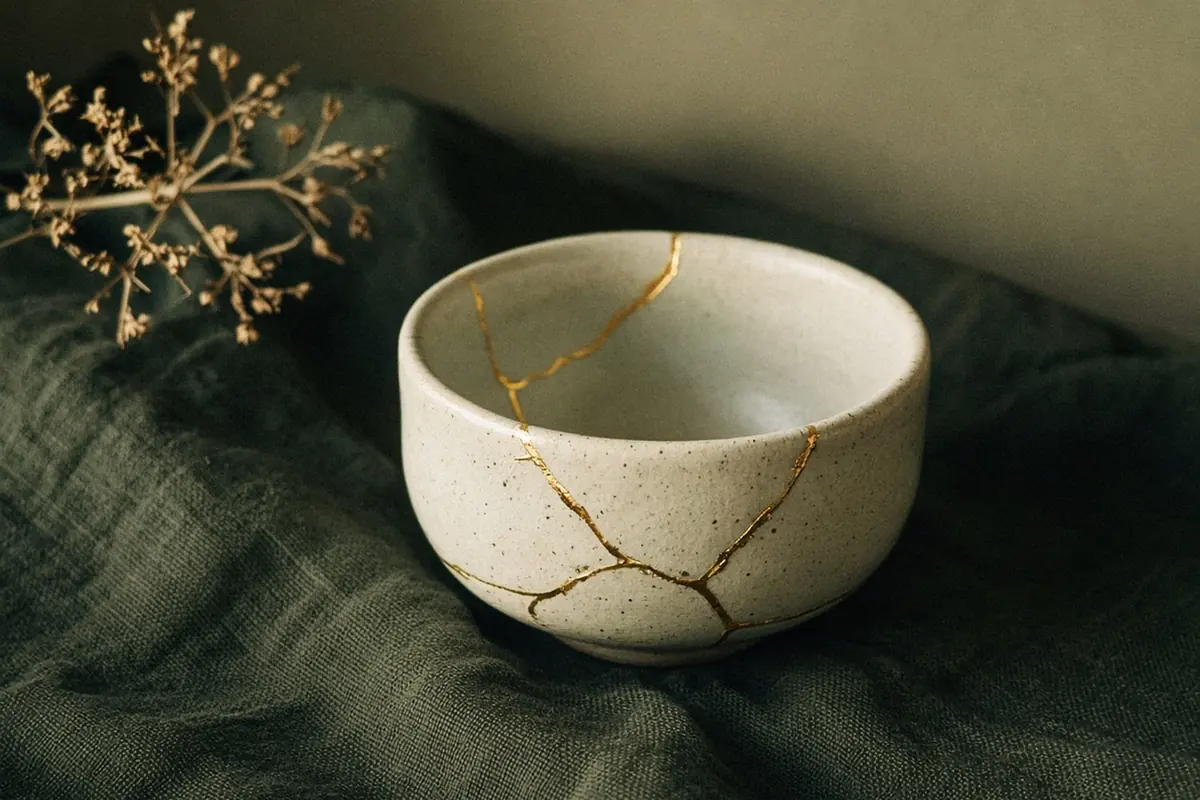
Kintsugi does not begin by restoring the whole service. It begins with the piece in front of you. After a disaster or a move, the piece might be a kettle, a document, a bed, a way to make the children's morning less frightening. Choose one useful thing and give it a place. Usefulness is not an insult to grief. It is how the day becomes a day again.
People will arrive with opinions about what you should feel. Grateful to be alive. Excited by a fresh start. Strong, because you have coped in public. You can be grateful and furious. You can have chosen the move and still mourn the street. You can cope at the relief centre and cry in the car. The gold line has room for more than one feeling, because the break was never only one feeling.
If help is clumsy, you may still need it. Let the clumsy help do the clumsy jobs: boxes, meals, forms. Save your finer truth for someone who can hold it without trying to renovate your face. Not every volunteer needs your whole story. A short thank you is a complete sentence.
Two places in one life
A move across countries, or even across a state, joins clays that were not fired together. Food tastes wrong and then, slowly, a dish from home and a dish from here can sit on the same table. Language tires the mouth. Humour arrives late. You are competent in one place and a beginner in another, and the beginner days bruise the pride of the competent person you still are.
Yobitsugi, the joining of different origins, is a fair image here if you hold it lightly. You are not required to become a seamless local, and you are not required to freeze yourself as a museum of the old country. A visible join means both places remain allowed. You can miss the rain you knew and learn the rain you have. You can keep a festival and accept an invitation to someone else's.
Children may adapt in ways that make adults feel left behind, or they may cling harder than adults expected. Neither response is a verdict on the decision to move. They are people with their own cure times. Tell them the truth in words they can carry: we left a real place, and we are making a real place, and both sentences can be loved.
After fire and after water
When a house has burned or flooded, the loss is not only things. It is the proof of days. The mug that knew a hand. The drawing on the fridge. Insurance, if it exists, speaks a language of replacement value. Replacement value cannot see that a cheap object was a relic. Grieve the relics even if a spreadsheet calls them minor.
Salvage what can be salvaged without harming your body. Leave what the smoke or the silt has made unsafe. Letting go of a ruined object is not a failure of loyalty. Sometimes the loyal act is to stop breathing the damage in. Photograph what you cannot keep, if a photograph helps, and then let the removalists do their work.
The first ordinary ritual back is worth more than a grand reopening. Boil water. Sit, even on a crate. Say a name, or a grace, or nothing. The workshop of a life restarts when one gentle action is repeated. Repetition is how a room becomes familiar again. Familiar is not the same as the old familiar. It is a new familiar with a line through it, and it can still be home.
Belonging without a performance
Belonging is often delayed, and the delay is not your fault. You can be kind, useful, and still feel provisional for a long time. Provisional is a hard feeling. It makes you over-explain. You do not owe the new street your entire history on the first introduction. Offer what you want to offer. The rest can stay lacquered until trust has a reason.
If faith travelled with you, it may feel both essential and strange in the new room. Songs you know by heart may be sung differently, or not sung. God, if God is your language, is not confused by the change of postcode. You are allowed to be confused. A prayer in the old tongue and a prayer in the new one can be the same gold line.
Community arrives in fragments: one reliable person, one bench that gets the afternoon light, one shop where they start to recognise the order. Do not despise the fragments because they are not a whole village yet. Villages are assembled. So are mended bowls.
If disaster is recent, practical help and official advice outrank any essay. Read this as company beside those tasks, not instead of them. Your worth was never stored only in the walls.
A question to sit with
What is the first useful thing you could put back on the bench, and which part of the old place deserves to stay visible in the new one?