Read · Foundations
Gold in the Cracks: Kintsugi and Scripture
A biblical reflection on clay, gold, and the God who stays near the broken-hearted. The image is borrowed. The verses are older than the bowl.
Mutsa Simango · 7 min read · Free
Kintsugi is not a Bible word. It comes from another country, another craft, another century of tea bowls and lacquer. Scripture does not need it. And yet, if you hold the two near each other without forcing a marriage, something quiet happens. The Bible already knows about clay. It already knows about breaks. It already knows a God who does not throw the vessel out at the first mar.
This reflection quotes the World English Bible, a public-domain revision, so the words can be copied with a clear conscience. Read them once, slowly. A kintsugi image can stay a guest in the room, not a landlord.
Treasure in clay
Paul writes to a congregation that knows pressure:
But we have this treasure in clay vessels, that the exceeding greatness of the power may be of God, and not from ourselves.
That is 2 Corinthians 4:7. The verse sits in a passage about being pressed, perplexed, pursued, and struck down, and about not being crushed, despairing, forsaken, or destroyed. Paul is not offering a craft hobby. He is talking about the knowledge of God carried in ordinary, breakable people. The clay is not an embarrassment beside the treasure. The clay is why no one can honestly say the power came from the vessel.
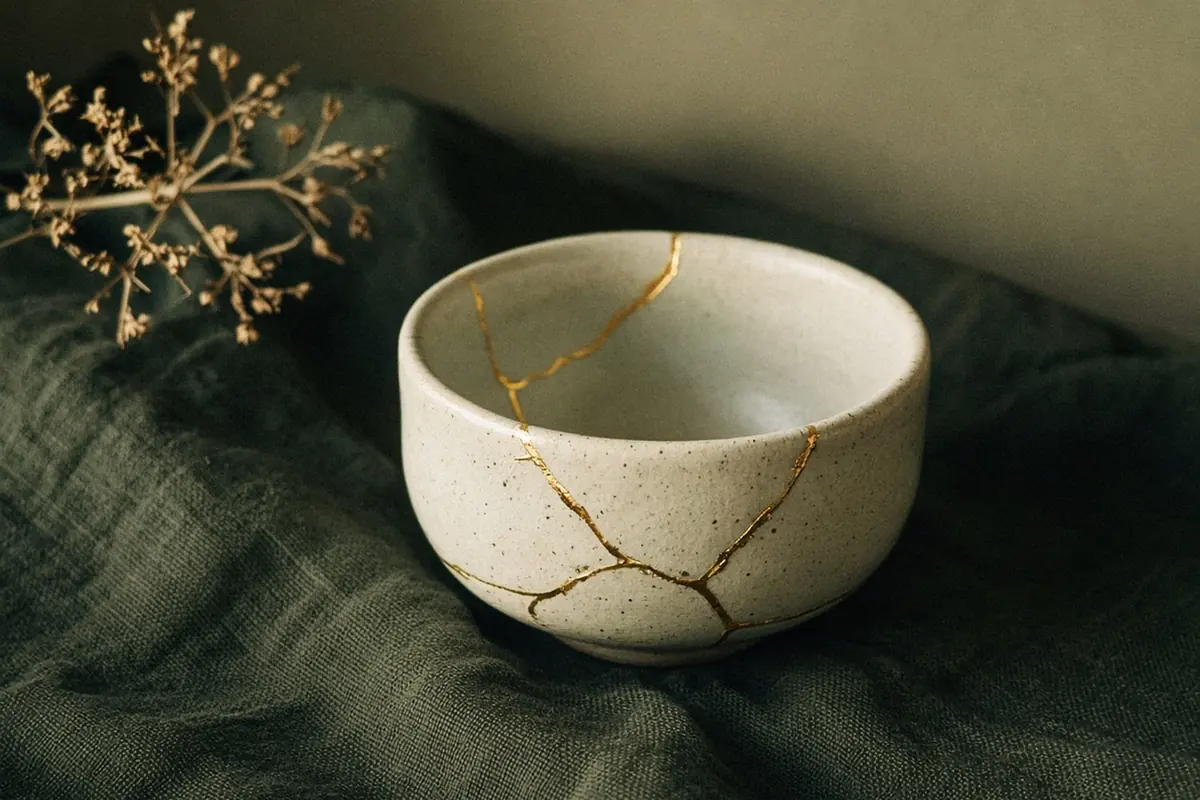
A kintsugi bowl makes the same confession in another language. The gold is visible because the clay failed to stay in one piece. The beauty of the line, if beauty is the right word, is not the clay congratulating itself. If you use this image in faith, let it keep that order. God is the treasure and the mender. You are not required to be the gold.
You can be a faithful person and a tired person in the same afternoon. The tiredness does not evict the treasure.
Near the broken-hearted
The psalms do not wait for you to be mended before they let you speak. Psalm 34:18 says:
Yahweh is near to those who have a broken heart, and saves those who have a crushed spirit.
Near. Not after. Not once you have found the lesson. The verse does not say the break was sent for your improvement, and this essay will not say it either. Some breaks are cruel, and calling them a gift too quickly is a way of refusing to sit beside someone. Nearness is different. Nearness is a God who does not leave the room because the feeling is untidy.
If your heart is broken, you do not have to invent a gold line in order to qualify for that nearness. The psalm is already addressed to you. Prayer can be one honest sentence. It can be silence in a chair. It can be another person reading this aloud because your own eyes are tired. Borrowed prayer is still prayer. A crushed spirit is not a failed spirit. It is a spirit telling the truth about weight.
Kintsugi can mislead here if it suggests that the point of the break is the eventual shine. The psalm's point is presence. Shine, if it comes, is a later kindness. Do not postpone the comfort of nearness until you feel presentable. Presentable is not the entrance requirement.
Ashes, oil, and a garment
Isaiah 61 is a passage Jesus reads in the synagogue and claims as his own work. Verse 3, in the World English Bible, says the anointed one comes:
to provide for those who mourn in Zion, to give to them a garland for ashes, the oil of joy for mourning, the garment of praise for the spirit of heaviness, that they may be called trees of righteousness, the planting of Yahweh, that he may be glorified.
Read the exchange carefully. Ashes are not denied. They are met with a garland. Mourning is not scolded. It is met with oil. Heaviness is not told to try harder. It is met with a garment. The order matters. Consolation comes toward the mourner. The mourner is not required to climb out of the ashes unassisted and then qualify for beauty.
A gold line along a crack is, at most, a small echo of that exchange. Ashes remain in the story. The garland does not pretend there was no fire. If you are mourning, you may hold this promise without feeling it yet. Feeling is not the same as truth. A tree of righteousness, in this verse, is a planting, not a performance. Plantings take the season they take. You are allowed to be in the ground.
The same chapter goes on to speak of rebuilding old ruins. That is hope with a broom in its hand. It does not cancel the mourning. It sits downstream of comfort. If someone offers you the rebuilding and withholds the comfort, they have torn the passage in half.
The potter's house
Jeremiah 18 is often quoted as if it were only a comfort. It is also a warning. Go and read the chapter when you can. The part that belongs beside a broken bowl is this, from verses 3 and 4:
Then I went down to the potter's house, and behold, he was making something on the wheels. When the vessel that he made of the clay was marred in the hand of the potter, he made it again another vessel, as seemed good to the potter to make it.
And verse 6:
House of Israel, can't I do with you as this potter? says Yahweh. Behold, as the clay in the potter's hand, so are you in my hand, house of Israel.
The clay is marred in the hand of the potter, and the potter does not discard the lump as worthless. Another vessel is made, as seems good to the maker. That is not the same sentence as: your pain was a plan you must celebrate. Jeremiah's chapter goes on to speak about nations turning, and about judgment. Context keeps us from turning the wheel into a slogan.
What you can carry home is narrower and stronger. You are not rubbish in the hand of God. A marred vessel is not the end of the maker's attention. The new shape may not be the shape you ordered. Faith, at this bench, is the willingness to be clay without demanding to supervise the wheel. That willingness can be very small on a hard day. Small willingness is still clay on the wheel.
Kintsugi and the potter are not the same image, and it is worth saying so. The potter reshapes. The kintsugi artisan repairs a fired form that has already broken, and leaves the history visible. Scripture has room for both: a God who makes new, and a God who does not erase the story of the break. Resurrection is not amnesia. The risen Jesus, in the Christian telling, is recognised in part by wounds. The wounds do not have the last word. They are not edited out of the word either.
How to borrow without stealing
Use these texts as themselves first. Kintsugi is a lantern you may carry into the room, not a replacement for the lamp that was already there. If the image helps you tell the truth, keep it. If it starts to prettify a wound that still needs a doctor, a friend, or justice, set it down. Scripture is not against help. The clay vessel is allowed to go to a physician. The broken-hearted are allowed to call a neighbour. Gold is not a substitute for bread.
If you want a simple way to pray with this, try four pauses. Read 2 Corinthians 4:7 and admit you are clay. Read Psalm 34:18 and ask for nearness rather than for a speedy shine. Read Isaiah 61:3 and name one handful of ashes without rushing to the garland. Read Jeremiah 18:4 and say, if you can, that you consent to be in the potter's hand today, without knowing the shape. Then stop. A long prayer is not holier than a true one.
The radio can stay on. A verse can be heard more than once. Repetition is how a line becomes something you can walk with, the way a thin vein of gold becomes something a bowl can trust.
A question to sit with
Which of these four words is the one you need today: clay, nearness, ashes, or the potter's hand, and what would it mean to let that word be enough for now?