Read · Foundations
The Legacy of Kintsugi
Where the gold line comes from, which parts are history and which are legend, and how to borrow the courage without claiming the craft.
Mutsa Simango · 6 min read · Free
Every image we love can be mishandled. Kintsugi has travelled far from the workshops where lacquer actually dries, and on the way it has picked up slogans. This essay is a slowing down. It asks what the craft is, what the famous story is worth, and what a person outside that tradition may honestly carry home. The point is not to become an expert in one sitting. The point is to stop using a beautiful word as if it had no elders.
A repair that tells the truth
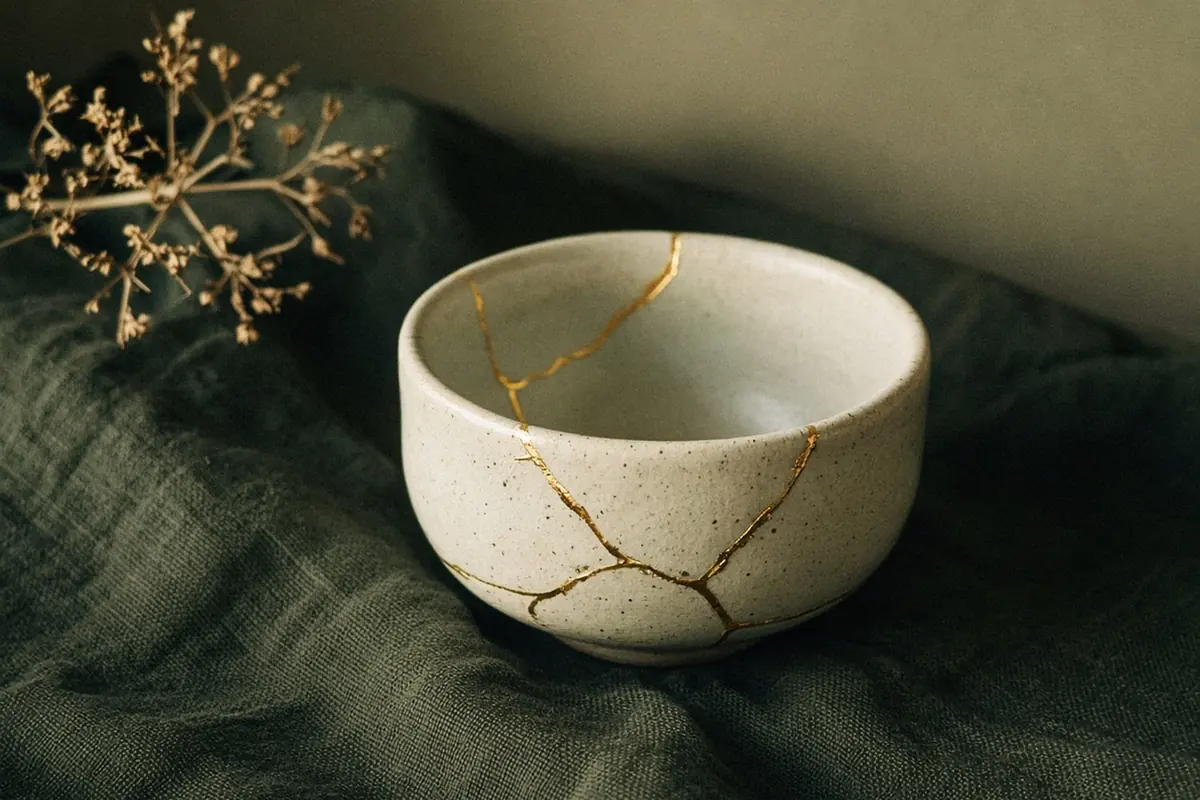
Kintsugi means golden joinery. You will also hear kintsukuroi, golden repair. The usual material is urushi, a lacquer drawn from a tree, worked in thin layers. Lacquer does not like to be rushed. It cures in damp air, over a stretch of time that would frustrate anyone selling a quick transformation. When the surface will hold it, a metal powder is laid into the line. Gold is the famous choice. Silver and other finishes exist. The gold is not paint slapped over a secret. It is the visible history of a join.
The bowl, cup, or jar returns to use. That matters. A repair meant only for a museum is a different kind of respect. Kintsugi, in its own house, is tied to the tea ceremony's care for particular objects: this bowl, these hands, this meeting, which will not be repeated. The object is not cherished because it is flawless. It is cherished because it has been chosen, used, broken, and kept.
If you remember nothing else, remember the order. Break. Patience. A line you can see. Use. The line is not an apology for the object. It is how the object stays in the room.
The legend, kept as a legend
A story is often told about Ashikaga Yoshimasa, a shogun linked with the Higashiyama culture and with the flowering of the tea ceremony in the fifteenth century. In the legend, a favoured Chinese tea bowl breaks. It is sent away for repair and comes back held together with ugly metal staples. The staples offend the eye. Craftsmen closer to home then find a way to mend the bowl with lacquer and gold, and a new aesthetic is born.
Tell it, if you tell it, as a legend. Historians do not treat that tale as a documented incident with a receipt and a date. The stapled repair of ceramics is a real technique in more than one culture, and lacquer repair in Japan has its own long life. The legend is a good story about a preference: better a honest, beautiful join than a mend that looks like a wound closed with wire and shame. The preference may be true even when the anecdote is not a court record.
Yoshimasa can stay in the picture as a patron of a culture that took tea, gardens, and imperfect beauty seriously. He does not need to be forced into the role of a single inventor so that the craft has a mascot. Crafts are rarely born in one disappointed afternoon. They are refined by many hands. Giving those hands back their share is part of respecting the legacy.
Wabi-sabi, without the poster
Wabi-sabi is the aesthetic weather around this craft. The words are hard to translate without thinning them. Together they gesture toward a beauty that includes imperfection, impermanence, and incompleteness. A chip, a fade, an asymmetry, a season ending: these are not problems the eye must solve before it is allowed to love. They are part of what a made thing, and a life, actually are.
The poster version says: flaws are beautiful, so cheer up. The older version is quieter. It says: stop demanding that the world be sealed and finished before you will look at it with respect. A tea bowl with an irregular lip is not a mistake that marketing has rebranded. It is a decision about what counts as enough.
Wabi-sabi can be misused to romanticise neglect. A person who is unsafe, unpaid, or unwell does not need an aesthetic theory about their suffering. Impermanence is a fact, not a reason to withhold help. Hold the idea as a way of seeing, and lay it down the moment it becomes a way of dismissing pain. A crack can be honoured and still be tended. Those are friends, not rivals.
Mottainai, the ache of waste
Mottainai is the sense that it is a shame to waste what still has life. The word can scold a child for leaving rice, and it can also name a deeper regret: throwing away a thing, a relationship, a day, or a self, before you have asked what remains usable. In the orbit of kintsugi, mottainai is why the pieces are kept. The bowl is not rubbish at the moment of the break. Rubbish is a decision made afterwards, sometimes too fast.
You can borrow this without borrowing a whole culture's manners. Before you discard a season of your life as a total loss, ask what still has life in it. A skill. A friendship. A faith that went quiet. A body that can do three things even if it cannot do thirty. The question is not sentimental. It is a form of accuracy. Waste is real, and so is the habit of calling something waste because it is no longer pristine.
Mottainai does not mean you must keep what harms you. A thing can have had life and still be right to release. The ache of waste is a pause, not a chain.
What not to claim
If you did not apprentice in lacquer, do not speak as if you had. Do not sell the image as if you invented it. Do not tell a grieving person that their loss is about to look lovely. Do not use a Japanese word as a costume at a dinner party and then ignore the people whose craft it is. Gratitude is specific. It sounds like: this way of repairing came from elsewhere, I am a guest, and here is the one courage I am taking home.
The courage is this. A break can be told. A mend can be slow. A life can return to the table with the line showing, and the showing is not shame. That courage does not require you to own the workshop. It requires you to stop demanding a flawless surface as the price of being kept.
Everlight's Kintsugi Corner lives in that guest room on purpose. The stories are not a manual in urushi. They are company for people whose lives have cracked, offered with the radio still on, and with a clear door back to ordinary help when an essay is not the right tool. Legacy, handled this way, is not a brand. It is a debt of attention.
A question to sit with
What have you been calling waste that may still have life in it, and what would it mean to honour the join without pretending the craft was yours to begin with?