Read · Grief
Losing someone you love
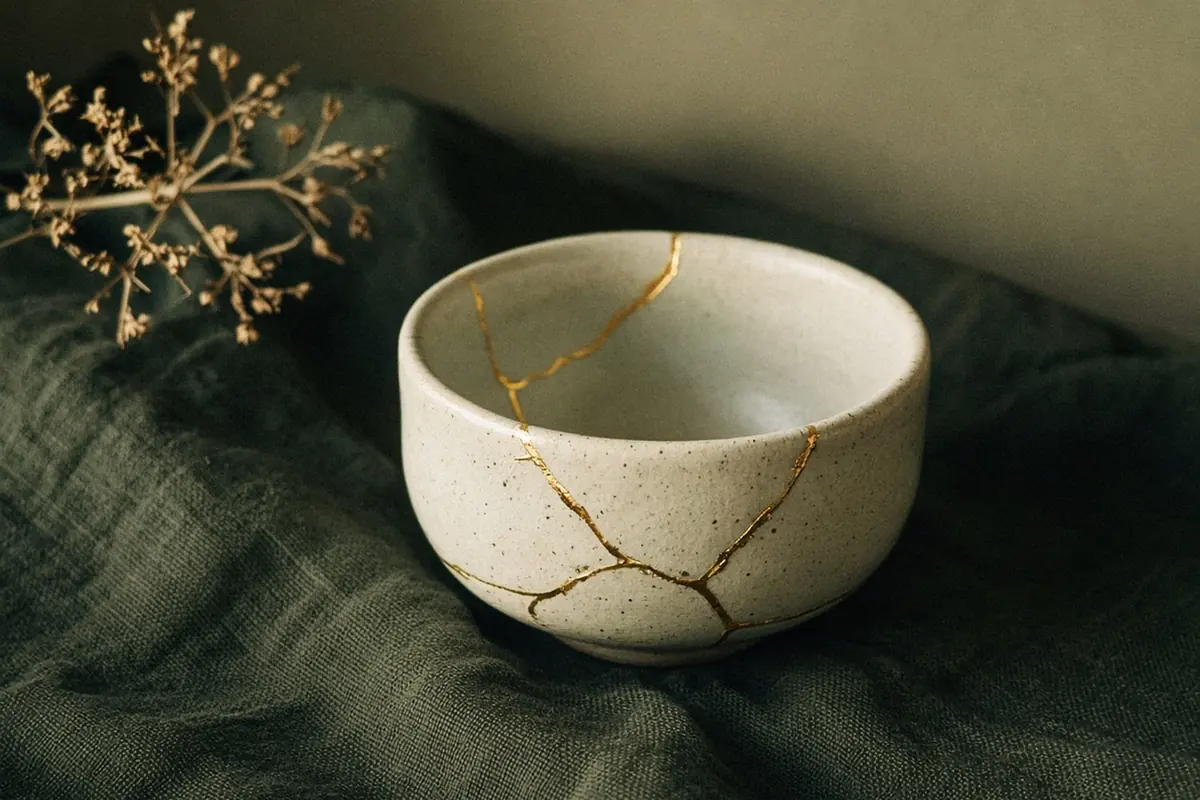
For the empty chair and the objects a person left behind. The gold line does not fill the space. It keeps the space honest.
Mutsa Simango · 5 min read · Free
Someone is missing, and the house has not caught up. The shoes are still by the door, or they are gone and the space they occupied is louder than the shoes ever were. People will tell you, kindly and too soon, that time will help. Time does change the shape of a day. It does not replace a person. Anyone who loved them already knows that, and it is a relief when a sentence admits it.
Kintsugi is a poor comfort if it is offered as a bow on top of a death. A gold line does not bring anyone back. What it can do is refuse the second loss, which is the pressure to pretend the first one left no mark.
The empty place is part of the room
In the stories of this path, ordinary objects do the talking. A porridge bowl. A second cup. A chair that still knows a body. The Japanese word ma is sometimes used for the meaningful interval, the space that is not empty of meaning just because it is empty of a thing. You do not have to learn the word. You only have to notice that the gap has a shape.
The gap might be a side of the bed. It might be the hour when a phone used to ring. It might be a joke that has no one left to finish it. Filling the gap too quickly can look like strength. Often it is fear. The room feels wrong, so we pile other duties into it until the wrongness is covered. The covered place is still there. It simply becomes harder to visit.
Leaving a small, honest space is not the same as refusing to live. You can cook. You can go to work. You can laugh at something foolish in the middle of the week and then feel the laugh land in a tender spot. The space can sit beside the living. It does not have to be the only furniture.
What people say, and what you can keep
Well-meaning sentences arrive like weather. They are in a better place. Everything happens for a reason. You are so strong. Some of those sentences are true in a faith you hold, and still badly timed. You are allowed to set them on a shelf and not use them yet. Faith is not a performance of cheerfulness for the comfort of the room.
You are also allowed to keep what other people find odd. A jumper. A voice note. A way of making tea that uses too much milk because that is how they took it. Keeping is not a failure to move on. Moving on is a phrase that often means: please become easier to be around. You do not owe anyone an easier grief.
If the relationship with the person who died was complicated, the crack has more than one line. Love and anger can occupy the same bowl. Relief and sorrow can too. Kintsugi does not sort the pieces into pure ones and shameful ones before it begins. The join shows where the break actually was. If your break includes unfinished words, those words can be part of the truth without being the whole truth.
The pace of lacquer
Real lacquer cures slowly, in the right damp air, and it cannot be hurried without spoiling the bond. Grief is not lacquer, and you are not a workshop. The likeness is only this: there is a pace that belongs to the material, and a faster pace that belongs to other people's discomfort.
Some days you will do one thing. Some days the one thing will be getting to the sink. That is not a small life. That is a life under a particular weather. If a body is tired because sorrow is heavy, the tiredness is information, not a character flaw. Rest is a way of keeping the pieces safe until you can hold them.
Other days a little gold shows up without an appointment. A memory that does not knock you over. A song you can hear all the way through. A meal that tastes of something. Do not interrogate those moments for proof that you are finished. They are not the end of the story. They are evidence that more than one thing can be true in the same afternoon.
Living with the line
To live again, in the sense this path means it, is not to become who you were. That person had them in the world. You are the one who knows the after. Living again can be as modest as learning the new map of the week: who you call, what you eat, which room you can bear at dusk.
The gold, if you want the image, is not shine for its own sake. It is the decision that this love remains visible. You say their name. You let a friend ask. You do not sand the relationship down until it is smooth enough for small talk. A mended bowl is used. It goes back to the table. It is not locked in a cabinet as a monument, and it is not thrown away as a mistake.
If you are caring for other people while you grieve, the line may have to be quieter in public and more honest in one safe place. Find the safe place. One person who can hear the unedited version is a form of gold. If you do not have that person yet, a page, a prayer, or this quiet reading can hold a sentence until you do.
None of this is a schedule. Anniversaries, seasons, and smells will ambush you, and the ambush is not a relapse. It is the bond doing what bonds do. You can be startled and still be mending.
A question to sit with
What empty place in your days still belongs to the one you love, and how might you let that place stay, without asking it to close?