Read · Foundations
What kintsugi teaches about brokenness
A quiet look at what a gold line can teach about a life that has cracked, and why the break does not have to be hidden.
Mutsa Simango · 5 min read · Free
A bowl slips. The sound is small and final. For a moment the kitchen holds its breath, and then someone reaches for the broom, because that is what a practical life does with a broken thing. Sweep it up. Wrap the sharp edges. Put the pieces where they cannot cut a bare foot in the dark.
Kintsugi begins one step earlier than the broom. It asks whether the pieces are still the bowl.
The break is not the verdict
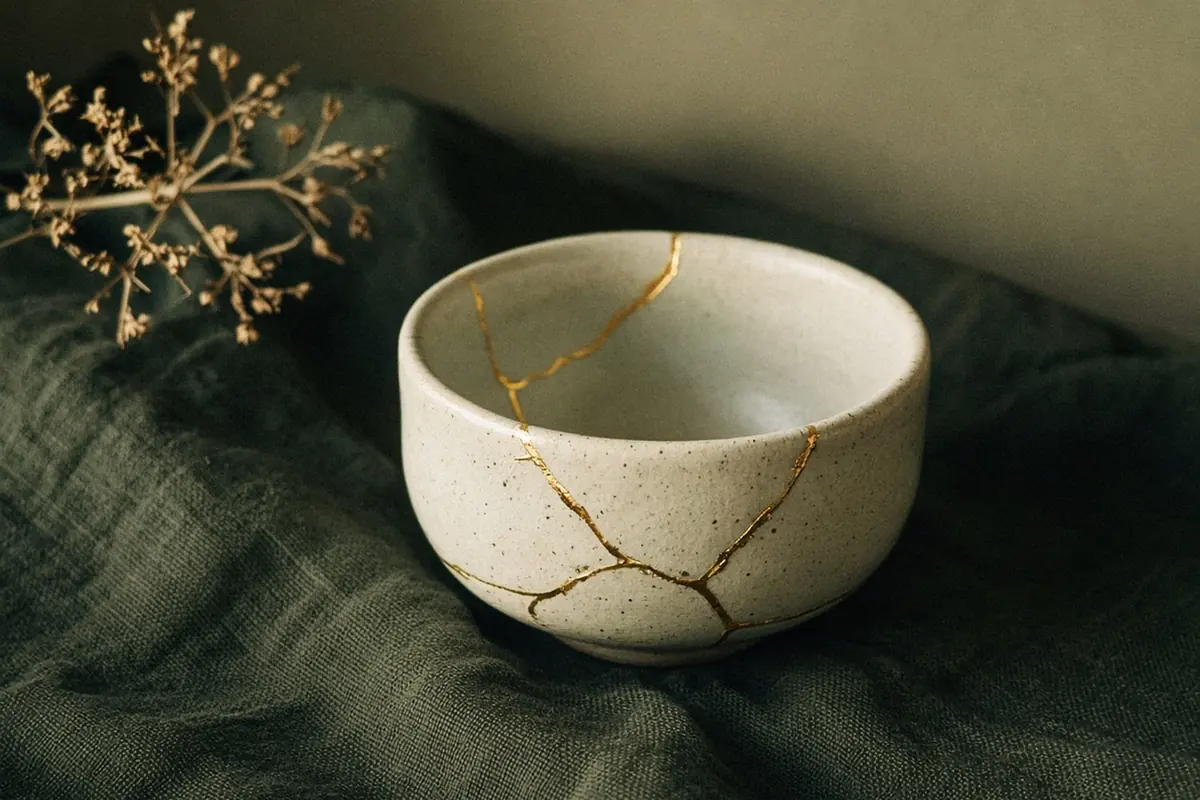
The word is often translated as golden joinery. Lacquer, patient and dark, is worked into the crack. Gold is laid along the line once the lacquer will hold it. The repair does not pretend the bowl was never dropped. The gold is there so the eye can find the break and still trust the vessel with hot water.
That is the whole teaching, and it is easy to rush past it. A culture that likes a clean before-and-after will turn the gold into a slogan: the damage made you beautiful. Kintsugi is sterner and kinder than that. The bowl was already a bowl. The break did not improve it. The break told the truth. The gold is a way of keeping the truth and the use of the thing in the same hand.
Mutsa has sat with this for a long time, in songs and in the stories of Kintsugi Corner. The image is borrowed. The craft belongs to a particular place and a particular patience, and it should not be worn like a costume. What can be borrowed is the courage to stop hiding the join.
What the line is not
The gold line is not a promise that pain will become pretty. Some cracks ache for years. Some never take a shine. A person can be faithful to a hard season and still wake up tired. If an image starts to scold you for not glittering yet, set the image down. It has stopped telling the truth.
The gold line is also not a reason to stay in what is harming you. A bowl can be mended. A person is not a bowl. Leaving a cruel room, asking for help, resting a body that has done enough: none of that is a failure of patience. Kintsugi keeps what still has life. It does not ask you to keep what is cutting you.
And it is not a craft you must master before you are allowed to feel ordinary again. You do not need the right words. You do not need a tidy story for other people. You need, perhaps, one honest sentence about what cracked, and the willingness not to throw the whole life out with the pieces.
Mottainai, said gently
There is a Japanese sense, mottainai, that something still has life in it and should not be wasted. It can sound like a rule about leftovers. Underneath, it is a form of respect. The bowl cost skill, clay, fire, and the hands that carried it to the table. To bin it at the first chip is to say that only the unbroken counts.
Lives collect chips. A move. A diagnosis. A silence in a family. A year that took more than it gave. The practical mind wants a replacement: a new city, a new personality, a version of you that does not mention the old one. Sometimes a new beginning is exactly right. Often, though, the life in front of you is the same life, with a line through it. Mottainai, borrowed carefully, says: look once more before you discard yourself.
Look for what still holds water. A friendship that did not leave. A joke you can still tell. A faith that went quiet but did not leave the house. A skill in your hands. The part of the story that is still true even if the ending changed. Those are not consolation prizes. They are the clay.
A visible mend
Hiding a repair has its own dignity. Some things are private, and privacy is not the same as shame. Kintsugi simply offers another choice: the mend can show. You can say, in your own words, that something broke and you are still here. You can let a friend see the line without turning the evening into a confession. You can pray without tidying the prayer first.
The lacquer in the real craft is slow because it has to cure. Nothing about that speed is a moral. It is a fact of the material. Grief, recovery, trust, and the rebuilding of a day have their own cure times. You cannot fan them into gold. You can keep the pieces in a safe place, and you can refuse the story that says a slow mend is no mend at all.
If you are new to this path, you do not have to know yet what has cracked. Some people arrive with a named loss. Some arrive with a weather in the chest and no name for it. Foundations are for both. The first kindness is to stop demanding a label before you are allowed to sit down.
One ordinary practice
Tonight, if you want a practice and not a performance, try this. Put one true thing on the table. It can be a cup, a photograph, a key, a name you say only in your own mouth. You do not have to explain it. You only have to let it be in the room without being solved.
Then notice one part of your life that still works, even a little. The kettle. The walk to the end of the street. The person who texts back. Say, quietly, that this too is the bowl. Not instead of the crack. Alongside it.
The radio can stay on. Nothing in this reading needs silence, though silence is welcome. A gold line is thin. It does not ask the whole room to rearrange itself. It asks to be seen.
A question to sit with
What in your life still holds, even with the line showing, and what would it mean to stop apologising for the line?