Read · Caring
Caring and growing older
Caring, and growing older, can be a long quiet loss that nobody sends flowers for. The slow work is still a mend.
Mutsa Simango · 5 min read · Free
Nobody sends flowers for the morning you drove again to the appointment, or for the night you slept lightly because someone else in the house might call out. Caring is full of unmarked hours. Growing older is full of them too: the name that arrives late, the hill that became a negotiation, the parents who are somehow both themselves and newly fragile. These are cracks that widen slowly. Because they do not announce themselves with one dramatic break, people underestimate the ache.
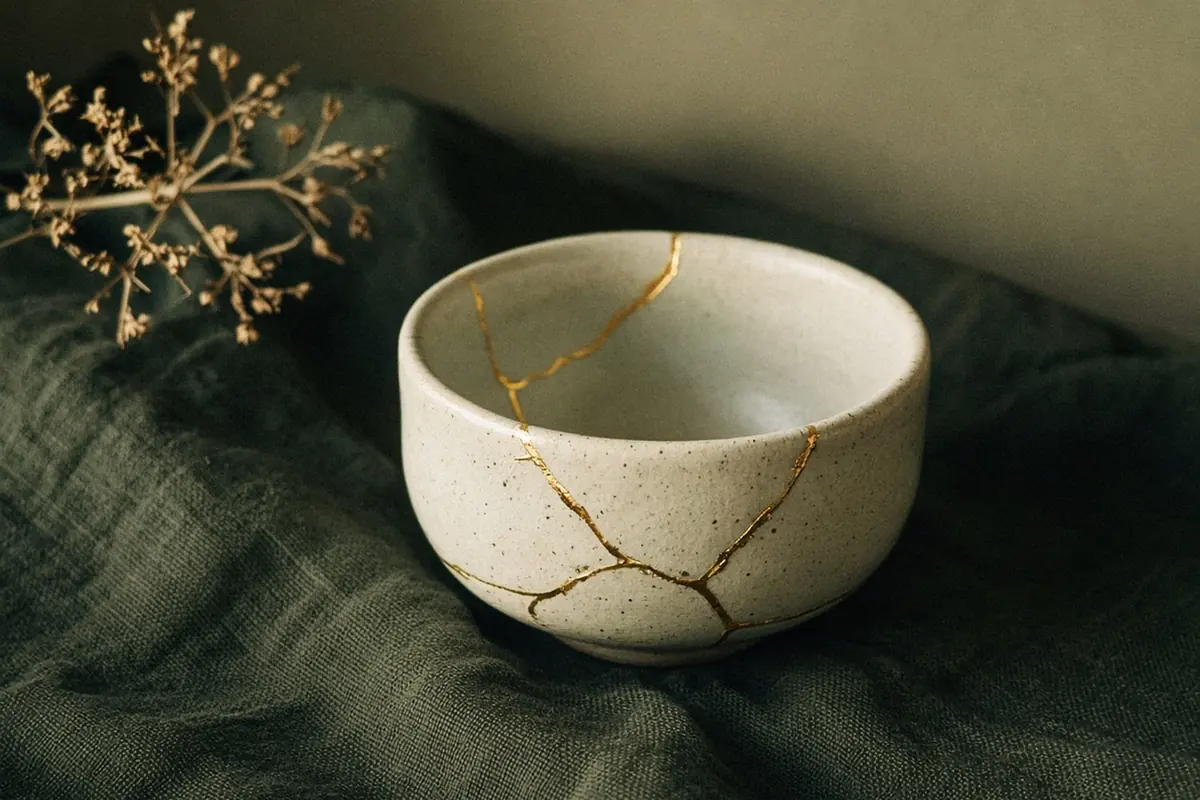
Kintsugi honours a line you can see. Much of caring is a line other people look past. This essay is a way of looking.
The long work is still work
If you are a carer, you already know the list. Medicines, meals, moods, the diplomacy of other relatives who visit and comment. You may love the person and resent the timetable, and the resentment does not cancel the love. A bowl can be precious and still be heavy to carry. Put the heaviness down in words somewhere, so it does not have to come out sideways at the person who cannot help the need.
You are allowed to be good at this and tired of it. Skill is not the same as an endless supply. When you take a break, the break is part of the care, because a collapsed carer cannot be a gentle one. Ask for the shift to be shared, even if the asking feels like a complaint. It is not a complaint. It is lacquer. It keeps the bond from cracking in a way nobody wanted.
If the person you care for is changing, grief arrives before death. That early grief is sometimes called ambiguous, because the person is in the room and also partly gone. You do not have to wait for a funeral to admit the loss of the conversations you used to have. Say their name as they are now, and keep a memory of who they were, without using the memory as a weapon against the present.
A body that is gathering years
Your own ageing deserves the same honesty. The culture likes a battle metaphor, as if a body were an enemy to defeat with products. A kinder image is the bowl that has been in service. It has heat marks. It has a chip. It still comes to the table. You do not have to be thrilled about every change. You also do not have to treat every change as a humiliation.
Strength may move from speed to judgment. Friendships may move from late nights to earlier cups of tea. Faith may move from certainty to a quieter trust, or it may be tested precisely because the old energy for church, temple, or prayer has thinned. None of these moves is a failure of your younger self. They are the craft of staying.
If illness is part of the ageing, return to the pace your body sets. Heroic schedules are how people break the very life they are trying to prove is fine. A visible mend says: I live at this speed now, and this speed is still a life.
What gets handed on
Legacy is not only a will. It is the jumper someone taught you to darn, the story told often enough that a younger person can tell it without you, the way you apologise, the way you do not. You are handing things on even when you are not trying to. It is worth choosing a few on purpose.
Choose what is true, not what flatters. A family that only inherits the polished version will be startled by their own cracks, and they will think the cracks mean they have left the family. Show a join. Tell one story in which you were wrong and made it right, or in which you could not make it right and lived honestly anyway. That story is gold. It gives the next person permission.
If there is no younger person in the house, legacy still exists. It exists in a neighbour, a student, a congregation, a friend you steady. It exists in the way you treat the person who serves your table. A life does not need an audience to be worth handing on. It needs a witness, even if the witness is you, paying attention.
Faith when the words won't come
Many people on this path have a faith that used to feel near and now feels like a song they cannot finish. Age and caring both tire the voice. Unfinished is not the same as absent. You can sit in the practice you can still manage: one psalm, one breath, one honest complaint spoken to God. Complaint has a long and holy history. It is not rudeness. It is relationship.
If you have left a community because it could not hold your doubt or your exhaustion, the leaving can be a mend rather than a break you must be ashamed of. Seek the room that does not require you to perform wellness. A small faithful practice in a quiet kitchen may be more true than a loud certainty you have to fake.
And if you are the one sitting with a parent whose faith is their last language, you can honour it without pretending it is yours, or you can share it without needing to win a debate. Omoiyari, a careful imagination of what another person needs, is a gentle guide here. Offer what steadies them. Do not steal their last comfort in order to be right.
The bowl goes back to the table
Caring and ageing can make a person feel like a monument: visited, commented on, not quite included in the ordinary meal. Insist, as far as you can, on use. Be in the conversation. Be in the joke. Let younger people see you do a small task slowly rather than watching them do everything while you disappear into a chair. Use is dignity.
On the days when use is not possible, presence is enough. A hand. A story told again. A radio left on so the room is not only illness. Everlight is built for rooms like that. You do not have to listen as a project. You can let a voice keep you company while the kettle boils.
You are not late. The line has been forming for years, and it is allowed to show.
A question to sit with
What slow loss have you been carrying without flowers, and what one true thing do you want the people after you to be able to see?